Hood Hums but Moves No Air
| Reads like | Actually is |
|---|---|
| A dead motor | A start component that has lost its charge — Blower Run Capacitor |
| Something jammed in the fan | A wheel that turns freely by hand once the power is off |
| The hood needs replacing | A part inside the canopy, with the canopy and the duct untouched |
| It got quieter, then stopped | Weeks of slow decline in the same component, not a sudden failure |
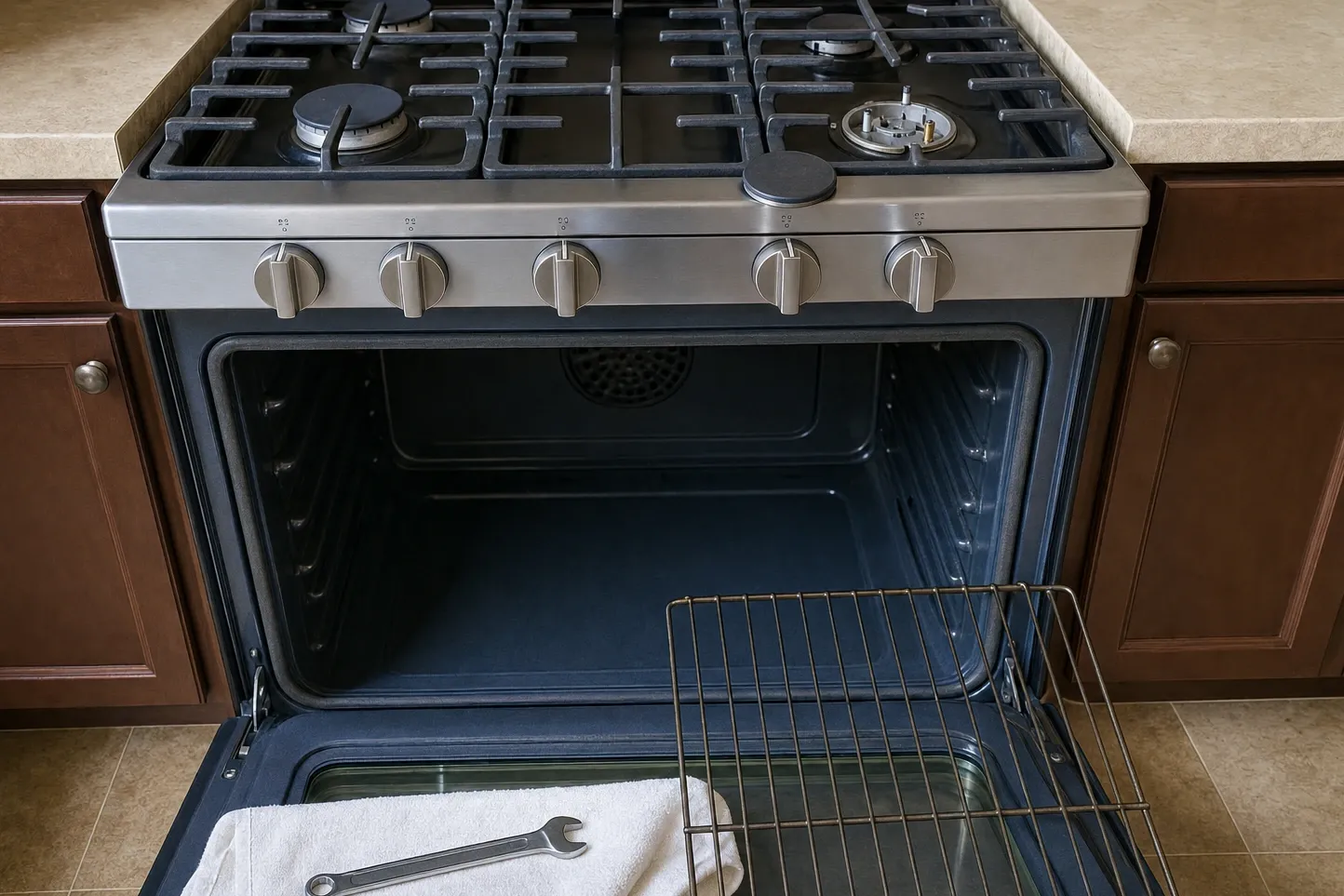
- Fan cover in the cavity
Why the hum is the useful part
Silence and a hum are two completely different faults wearing the same coat. Silence means nothing is arriving at the motor: a switch, a board, a wall control or, on a remote blower, a long run of low-voltage cable between the hood and a unit that is nowhere near the kitchen. A hum means the power got there and the motor could not act on it — the windings are energised and the rotor is standing still.
That narrows it fast. A motor with a failed winding usually goes quiet, not loud. A motor being held by a seized bearing or a wheel packed hard with grease will hum, and so will a perfectly good motor whose start component has aged out. The last of those is the most common by a wide margin, and it is also the cheapest thing on the list.
What the visit actually does
The wheel gets turned by hand with the power off, which separates a mechanical jam from an electrical one in about ten seconds. If it spins freely, attention moves to the start component and a capacitance meter, read against the rating printed on the case. If the wheel is stiff or loaded, the wheel and the bearings are the conversation instead.
The diagnosis is the same whether the motor is in your canopy, in the attic above it or on the roof. Access is not — a remote unit means the meter goes where the motor is, and that is worth knowing before anyone quotes you.
What you can look at yourself
- Switch the hood off at the control. A motor left humming is drawing current and heating up, and nothing useful happens while it does.
- Take the filters out and look up at the wheel with a torch. It should be a caged drum of curved blades, and nothing should be leaning on it.
- Try every speed. A hum on all of them says the same thing; a hum on one and silence on the others moves the suspicion to the switch bank instead.
- Check the breaker for the kitchen. A hood on a shared circuit with a tripped leg can hum on residual control power and go nowhere.
- Stop there. Anything behind a panel, above the cabinets or on a roof is the visit — Wolf Repair Los Angeles, (310) 626-4008.
Follow-ups
Can I give the wheel a push to get it started?
Not with the power on, and not as a fix. A blower that only runs after a nudge has already told you what is wrong, and every start from then on is hard on the windings. Switch it off, leave it off, and have the start component measured rather than nursing it through another few weeks.
Does a humming hood mean the motor is about to burn out?
It can if it is left humming. A stalled motor keeps drawing current without the airflow that normally cools it, and that is what turns a cheap repair into an expensive one. Switching it off the day it starts is genuinely the difference, which is why that is the first line on this page.